5 Essential Public Speaking Tips to Boost Confidence

Imagine standing in front of a room full of eyes fixed on you—heart racing, palms sweaty. Sound familiar? You’re not alone. About 75% of people fear public speaking more than death. But here’s the good news: with the right public speaking tips, you can turn that dread into delight. This guide shares 15 practical strategies to help beginners and pros alike shine on stage. Whether you’re prepping for a work presentation or a wedding toast, these steps will build your confidence and captivate any crowd. Let’s dive in and make you a speaking star.
Overcoming the Fear of Public Speaking
Fear of public speaking, or gloss phobia, affects millions—around 15 million Americans daily. The key? Reframe it as excitement. As Mark Twain quipped, “It usually takes me more than three weeks to prepare a good impromptu speech.” Start small to build momentum.
Breathe Deep to Stay Calm
Nerves spike your heart rate, but controlled breathing flips the script. Try the 4-7-8 technique: Inhale for 4 seconds, hold for 7, exhale for 8. Do this before stepping up.
- Why it works: It activates your body’s relaxation response, lowering anxiety in seconds.
- Pro tip: Practice during mock talks to make it a habit.
[Suggested image: A serene speaker taking deep breaths on stage, with a simple breathing diagram overlay.]
Admit Your Nerves—It Builds Connection
Don’t hide the jitters; own them. Say, “I’m a bit nervous today, but excited to share this with you.” Audiences relate and root for you more.
Research from Harvard shows vulnerability fosters trust, making your message land harder.
Preparing Your Speech Like a Pro
Great delivery starts with solid prep. Skip winging it—structure your talk to flow naturally. John F. Kennedy nailed it: “The only reason to give a speech is to change the world.” Aim high, but keep it simple.
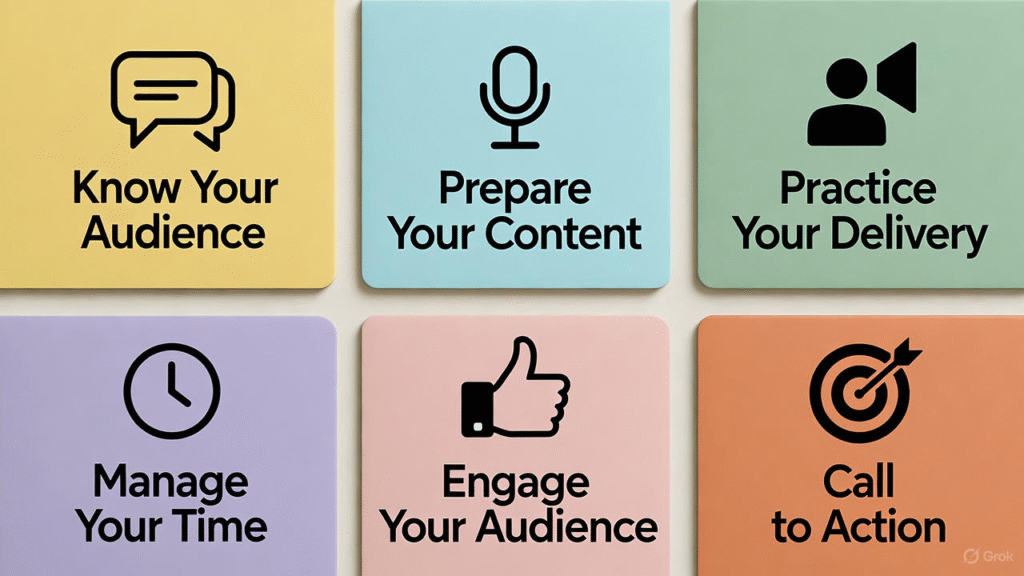
Know Your Audience Inside Out
Tailor your content to who’s listening. Are they experts or newbies? Use jargon sparingly for pros; explain basics for beginners.
- Action step: Survey a few attendees beforehand or research the event’s vibe.
- Example: For a tech crowd, dive into data; for families, weave in stories.
This boosts relevance and engagement, per Toastmasters experts. External link: Check Toastmasters’ audience analysis guide.
Organize with a Clear Structure
Every speech needs a roadmap: opener, body, close. Limit to 3 main points for easy recall.
Here’s a quick template:
- Hook: Start with a question or stat (e.g., “Did you know 75% fear this?”).
- Body: Share stories or facts per point.
- Close: End with a call to action.
Keep it under 10 minutes for most talks—attention spans average 8 seconds today.
[Suggested infographic: A flowchart showing the speech structure with icons for hook, body, and close.]
Mastering Delivery: Body Language and Voice
Words matter, but how you say them seals the deal. Nonverbal cues make up 55% of communication, says body language expert Albert Mehrabian.
Harness Powerful Body Language
Stand tall, gesture openly, and move with purpose. Avoid crossing arms—it signals defense.
- Tips for impact:
- Smile to warm up the room.
- Use open palms to emphasize points.
- Scan the crowd evenly, holding eye contact for 3-5 seconds per person.
Watch TED Talks for demos—speakers like Amy Cuddy use posture to command respect. External link: Amy Cuddy’s TED Talk on power poses.
Vary Your Voice for Engagement
Monotone kills momentum. Mix pitch, pace, and volume like a pro DJ.
- Practice drill: Record yourself reading a paragraph. Amp up excitement on key phrases.
- Expert insight: “Vary your tone, volume, and speed,” advises Verywell Mind.
Engaging Your Audience Every Time
Boring speeches flop. Make yours interactive to keep ears perked. As Guy Kawasaki says, “Simple and to the point is always the best way to get your point across.”
Weave in Stories and Humor
Facts inform; stories transform. Share a quick personal fail-turned-win to humanize yourself.
- Humor hack: Self-deprecating jokes work best—e.g., “I once blanked mid-speech and blamed the mic. Spoiler: It was on.”
- Data boost: Stories increase retention by 22 times over facts alone, per Stanford research.
Ask Questions and Poll the Room
Pull them in: “Raise your hand if you’ve ever frozen on stage.” It creates buy-in.
For virtual talks, use polls via tools like Mentimeter.
Practice Makes Perfect: Drills That Stick
No magic pill—repetition builds skill. Purdue Global recommends practicing aloud 5-7 times.
Step-by-Step Practice Routine
- Write it out: Script your full talk.
- Rehearse solo: Time yourself in front of a mirror.
- Go public: Record or present to friends for feedback.
- Refine: Tweak weak spots, like filler words (“um,” “like”).
- Simulate stress: Practice in unfamiliar spots.
Aim for 80% familiarity—not memorization—to sound natural. Join a group like Toastmasters for real-world reps. External link: Find a local Toastmasters club.
[Suggested image: A timeline graphic of the practice steps, with checkmarks.]
Common Pitfalls to Avoid
Even pros slip. Dodge these for smoother sails:
- Overloading slides: One idea per slide, max 5 words.
- Rushing the end: Pause after your closer—let it sink in.
- Ignoring Q&A: Prep for tough questions to stay poised.
Saint Leo University notes minimal notes prevent reading disasters.
Wrapping Up: Your Path to Speaking Success
Mastering public speaking tips isn’t overnight magic—it’s consistent, fun effort. From breathing through fear to storytelling that sticks, these 15 strategies equip you to inspire confidently. Remember, every great speaker started nervous. As Plato put it, “Rhetoric is the art of ruling the minds of men.”
Ready to shine? Pick one tip, practice this week, and share your win in the comments. Or join a speaking club today—your audience awaits!